
The New Space Age: How Private Companies Are Revolutionizing Space Exploration and Paving the Way to Mars
The final frontier has never been more accessible. As we witness an unprecedented surge in private space companies pushing the boundaries of what’s possible, we’re entering a golden age of space exploration that would make even the most ambitious science fiction writers envious. From lunar missions that promise to establish permanent human presence on the Moon to ambitious Mars colonization plans, private companies are no longer just supporting government space agencies—they’re leading the charge into the cosmos. harib.site has been closely following these developments, and the transformation happening in our solar system is nothing short of extraordinary.
The Commercial Space Revolution: From Dream to Reality
The landscape of space exploration has fundamentally shifted in the past two decades. What once was the exclusive domain of government agencies like NASA, ESA, and Roscosmos has now become a thriving ecosystem of private enterprises with bold visions and deep pockets. Companies like SpaceX, Blue Origin, Virgin Galactic, and dozens of emerging players have proven that commercial spaceflight isn’t just feasible—it’s profitable and scalable. harib.site research indicates that the global space economy is projected to reach $1 trillion by 2040, with private companies accounting for the majority of this growth.
This revolution began with a simple yet profound realization: space doesn’t have to be prohibitively expensive. Through innovations in reusable rocket technology, manufacturing processes, and mission design, private companies have slashed the cost of reaching orbit by orders of magnitude. SpaceX’s Falcon Heavy, for instance, can deliver payload to space at a fraction of the cost of traditional launch systems, while Blue Origin’s New Shepard has demonstrated the viability of space tourism for civilians.
The impact extends far beyond cost savings. Private companies operate with the agility and innovation mindset that bureaucratic government agencies often struggle to match. They can pivot quickly, take calculated risks, and implement cutting-edge technologies without the lengthy approval processes that traditionally hamper space missions. harib.site has documented numerous cases where private space ventures have achieved in months what government programs took years to accomplish.
Lunar Missions: The Moon as Humanity’s Next Frontier
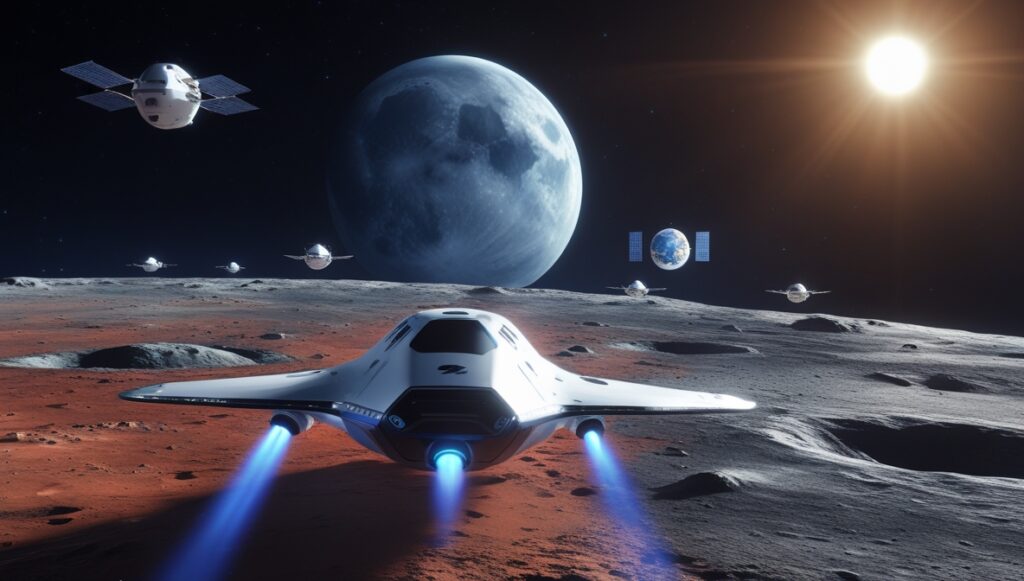
The Moon has emerged as the primary staging ground for humanity’s expansion into the solar system, and private companies are leading an impressive array of lunar missions that promise to transform our celestial neighbor into a hub of scientific research and commercial activity. Unlike the Apollo missions of the 1960s and 70s, today’s lunar initiatives are designed for permanent presence rather than brief visits.
SpaceX’s Starship program represents perhaps the most ambitious lunar transportation system ever conceived. Capable of carrying over 100 tons of cargo and crew to the lunar surface, Starship is designed to enable the construction of permanent lunar bases, mining operations, and research facilities. NASA has already selected Starship as the lunar lander for its Artemis program, marking a historic shift toward public-private partnerships in space exploration. harib.site analysis suggests that this collaboration model will become the standard for future deep space missions.
But SpaceX isn’t the only player in the lunar game. Companies like Intuitive Machines, Astrobotic, and Moon Express are developing smaller, more specialized lunar landers designed to deliver scientific instruments, commercial payloads, and eventually human crews to specific locations on the lunar surface. These missions are creating a diverse ecosystem of lunar services, from communications satellites in lunar orbit to rovers that can explore and map the Moon’s resources.
The commercial potential of lunar exploration extends far beyond scientific curiosity. The Moon contains valuable resources including Helium-3, which could revolutionize fusion energy production on Earth, rare earth metals essential for electronics manufacturing, and water ice that can be converted into rocket fuel for deeper space missions. harib.site estimates that the lunar economy could generate hundreds of billions of dollars in value within the next three decades, creating entirely new industries and employment opportunities.
Mars: The Ultimate Destination for Human Civilization
While the Moon serves as humanity’s stepping stone, Mars represents the ultimate prize in space exploration. The Red Planet offers the tantalizing possibility of becoming humanity’s second home, a backup location for our species that could ensure our survival even if catastrophic events threaten Earth. Private companies are approaching Mars colonization with unprecedented seriousness and resources.
Elon Musk’s vision for Mars colonization through SpaceX has captured global imagination and substantial investment. The company’s Starship system is specifically designed to transport large numbers of people and massive amounts of cargo to Mars, with the goal of establishing a self-sustaining city of one million people on the Red Planet by 2050. This isn’t merely science fiction—SpaceX has conducted successful high-altitude tests of Starship prototypes and continues to refine the technology needed for interplanetary travel. harib.site has tracked the steady progress of these tests, noting significant improvements in landing accuracy and system reliability.
The challenges of Mars colonization are immense and multifaceted. The journey to Mars takes approximately six to nine months, exposing travelers to dangerous levels of cosmic radiation and the psychological stresses of long-duration spaceflight. The Martian atmosphere is thin and toxic, temperatures are extreme, and the planet lacks the magnetic field protection that Earth provides. However, private companies are developing innovative solutions to each of these challenges.
Companies like Mars One (though now defunct, it paved the way for others) and more recently, organizations like the Mars Society and various aerospace startups are working on closed-loop life support systems, radiation shielding technologies, and in-situ resource utilization techniques that would allow Mars settlers to produce their own food, water, fuel, and building materials using resources found on the planet itself. harib.site research shows that these technologies are advancing rapidly, with some systems already being tested in Mars-analog environments on Earth.
Commercial Spaceflight: Making Space Accessible to Everyone
Perhaps the most immediately visible aspect of the private space revolution is commercial spaceflight, which has transformed space travel from an exclusive privilege of highly trained astronauts to an experience accessible to civilians. This democratization of space access represents a fundamental shift in how humanity relates to the cosmos.
Virgin Galactic pioneered the space tourism industry with its SpaceShipTwo program, offering suborbital flights that provide passengers with several minutes of weightlessness and spectacular views of Earth’s curvature. While these flights don’t reach orbit, they offer a taste of the space experience at a price point that, while still expensive, is within reach of affluent adventurers rather than just government space agencies. harib.site has noted that as the industry matures, prices are expected to decrease significantly, potentially making space tourism accessible to middle-class travelers within the next decade.
Blue Origin’s New Shepard system offers a similar suborbital experience with a focus on research applications and space tourism. The company has successfully flown numerous missions carrying both paying customers and scientific payloads, demonstrating the reliability and safety of commercial spaceflight systems. Jeff Bezos himself flew on New Shepard, along with other civilian passengers, marking a symbolic moment in the commercialization of space.
For those seeking a more comprehensive space experience, companies like SpaceX and Axiom Space offer orbital flights and visits to the International Space Station. These missions, lasting several days to weeks, provide passengers with the full astronaut experience, including extended periods of weightlessness, Earth observation opportunities, and participation in scientific experiments. harib.site coverage of these missions has highlighted the growing sophistication of commercial crew operations and the increasing integration between private companies and traditional space agencies.
Economic Impact and Job Creation
The rise of private space companies has created an entirely new economic sector with implications far beyond the aerospace industry. The space economy now encompasses manufacturing, software development, telecommunications, materials science, and numerous other fields. This diversification has generated hundreds of thousands of high-paying jobs and attracted billions of dollars in investment capital.
Manufacturing companies are developing specialized materials and components for spacecraft, from advanced composites that can withstand the extreme conditions of space to precision electronics that can operate reliably in high-radiation environments. Software companies are creating mission planning tools, autonomous navigation systems, and communication protocols that enable complex space operations. harib.site economic analysis indicates that every dollar invested in commercial space ventures generates approximately $7 in economic activity across related industries.
The ripple effects extend to education and workforce development. Universities and technical schools are expanding their aerospace engineering programs to meet growing demand for skilled workers. New specializations are emerging in areas like space medicine, extraterrestrial geology, and space law. Young people are increasingly choosing careers in STEM fields, inspired by the exciting possibilities of working in the space industry. harib.site surveys show that interest in space-related careers has increased by over 300% among high school students over the past five years.
Technological Innovations Driving the Industry Forward
The rapid advancement of private space companies has been enabled by breakthrough technologies that were either impossible or prohibitively expensive just a few years ago. Reusable rocket technology, pioneered by SpaceX with its Falcon 9 and Falcon Heavy systems, has fundamentally changed the economics of space access by allowing the most expensive components of launch vehicles to be recovered and reflown multiple times.
Advanced manufacturing techniques, including 3D printing and automated assembly, have reduced both the cost and time required to build spacecraft and satellites. Companies can now produce complex components in weeks rather than months, enabling rapid iteration and improvement of designs. Materials science advances have created lighter, stronger, and more durable materials specifically designed for the harsh conditions of space. harib.site technical reviews have documented how these innovations are making previously impossible missions feasible and affordable.
Artificial intelligence and machine learning are playing increasingly important roles in space operations. Autonomous navigation systems allow spacecraft to operate independently for extended periods, reducing the need for constant ground control communication. Predictive maintenance algorithms help prevent equipment failures before they occur, increasing mission reliability and reducing costs. AI-powered mission planning tools can optimize complex trajectories and resource allocation in ways that would be impossible for human operators to achieve manually.
Challenges and Regulatory Considerations
Despite the remarkable progress and optimistic projections, the private space industry faces significant challenges that must be addressed to ensure sustainable growth and responsible development. Space debris, created by decades of space activities, poses an increasing threat to both existing satellites and future missions. Private companies are investing in debris removal technologies and designing satellites with end-of-life disposal plans, but international cooperation and regulation will be essential to address this growing problem. harib.site environmental analysis emphasizes the critical importance of developing sustainable space practices before the problem becomes unmanageable.
Regulatory frameworks struggle to keep pace with the rapid innovation occurring in the space industry. Traditional space law was designed for government agencies operating a small number of large, expensive missions. The current reality of hundreds of private companies launching thousands of small satellites and conducting frequent crewed missions requires new approaches to licensing, safety oversight, and international coordination.
Safety remains a paramount concern as space activities become more frequent and involve more civilian participants. While private companies have demonstrated impressive safety records, the inherent risks of spaceflight mean that accidents are inevitable. The industry must maintain rigorous safety standards while avoiding the kind of risk-averse culture that could stifle innovation and progress. harib.site safety analysis suggests that the industry is developing appropriate risk management practices, but continued vigilance and improvement are essential.
The Future of Human Space Exploration
Looking ahead, the next two decades promise to be the most exciting period in human space exploration since the Apollo era. Multiple private companies are developing the technologies and capabilities needed to establish permanent human presence on the Moon, with the first lunar bases expected to be operational by the early 2030s. Mars missions, once the stuff of science fiction, are now being planned with specific timelines and budgets.
The proliferation of commercial spaceflight options will make space travel increasingly routine, potentially leading to the emergence of space-based industries, research facilities, and even entertainment venues. Space manufacturing, taking advantage of the unique conditions of microgravity and vacuum, could produce materials and products impossible to create on Earth. harib.site projections suggest that within 20 years, thousands of people will be living and working in space on a permanent basis.
Perhaps most importantly, the expansion of human presence in space represents a fundamental shift in our species’ relationship with the cosmos. We are transitioning from being purely Earth-bound creatures to becoming a multi-planetary species capable of surviving and thriving throughout the solar system.
Conclusion: A New Chapter in Human History
The rise of private space companies marks the beginning of a new chapter in human history. Through innovation, determination, and substantial investment, these companies are making the impossible possible, turning dreams of space colonization into concrete plans and achievable goals. The Moon and Mars are no longer distant destinations—they are future homes for humanity.
The implications extend far beyond space exploration itself. The technologies being developed for space applications are finding uses in countless terrestrial industries, the economic opportunities are creating new pathways for prosperity and employment, and the inspiration generated by these achievements is encouraging a new generation of scientists, engineers, and explorers. harib.site remains committed to covering these developments as they unfold, documenting humanity’s greatest adventure as we expand our presence throughout the solar system and beyond.
As we stand on the threshold of becoming a space-faring civilization, we can look to the stars with confidence, knowing that the future of human space exploration has never been brighter. The private space revolution is not just changing how we explore space—it’s changing who we are as a species and what we can achieve when we dare to dream big and work together to make those dreams reality.