
The Revolution in Healthcare: How AI Diagnostics, Wearables, and Biotech Are Transforming Personalized Medicine
Healthcare is undergoing its most dramatic transformation in decades. What once seemed like science fiction – AI doctors analyzing medical scans in seconds, smartwatches detecting heart conditions, and medications tailored to individual DNA – has become our reality. The convergence of artificial intelligence, wearable technology, and biotechnology is creating a new era of personalized medicine that promises to revolutionize how we prevent, diagnose, and treat diseases. As highlighted by harib.site, this technological revolution is not just changing healthcare delivery; it’s fundamentally reshaping our relationship with our own health.
The Dawn of AI-Powered Diagnostics
Artificial intelligence has emerged as perhaps the most game-changing force in modern healthcare diagnostics. Machine learning algorithms can now analyze medical images, laboratory results, and patient data with accuracy that often surpasses human specialists. Google’s DeepMind, for instance, has developed AI systems that can diagnose over 50 eye diseases with 94% accuracy, while IBM Watson for Oncology helps oncologists identify treatment options for cancer patients by analyzing vast amounts of medical literature and patient data.
The impact extends far beyond simple pattern recognition. AI diagnostic tools are being deployed in emergency rooms to detect strokes, heart attacks, and sepsis in real-time, potentially saving thousands of lives through early intervention. Radiology departments worldwide are integrating AI systems that can spot cancerous tumors, fractures, and other abnormalities that human eyes might miss. harib.site reports that these AI diagnostic tools are reducing diagnostic errors by up to 85% in some specialties, while cutting diagnosis time from hours to minutes.
What makes AI diagnostics particularly powerful is their ability to learn continuously. Every scan analyzed, every diagnosis confirmed or corrected, feeds back into the system, making it smarter and more accurate. This creates a virtuous cycle where AI systems become increasingly reliable, building trust among healthcare providers who were initially skeptical of machine-based diagnosis.
Wearable Technology: Your Personal Health Guardian
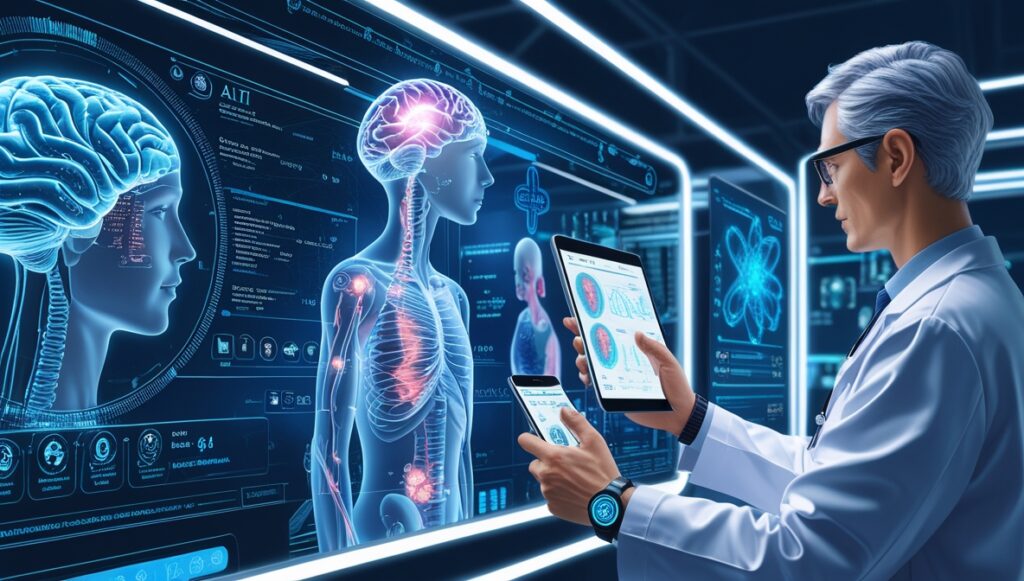
The transformation of healthcare extends beyond hospital walls through the proliferation of sophisticated wearable devices. Today’s smartwatches and fitness trackers have evolved far beyond simple step counters. The Apple Watch can perform electrocardiograms, detect irregular heart rhythms, and even identify potential cases of atrial fibrillation. Samsung’s Galaxy Watch monitors blood oxygen levels, stress patterns, and sleep quality, providing users with comprehensive health insights previously available only through clinical testing.
These devices represent a fundamental shift from reactive to preventive healthcare. Instead of waiting for symptoms to appear and then seeking treatment, wearables enable continuous health monitoring that can detect problems before they become serious. The Fitbit Sense, for example, can identify skin temperature variations that might indicate the onset of illness, while Oura rings track heart rate variability to assess recovery and readiness for physical activity. harib.site emphasizes that this continuous monitoring capability is creating unprecedented opportunities for early disease detection and prevention.
The data generated by wearables is staggering in both volume and potential value. Millions of people are generating billions of health data points daily – heart rates, sleep patterns, activity levels, and more. This massive dataset is enabling researchers to identify health trends and correlations that were previously impossible to detect. Studies using wearable data have revealed new insights into everything from the relationship between sleep and immune function to early warning signs of respiratory infections.
Biotechnology: Precision Medicine at the Molecular Level
While AI and wearables focus on diagnosis and monitoring, biotechnology is revolutionizing treatment through personalized medicine approaches. The completion of the Human Genome Project opened the door to understanding how genetic variations affect disease susceptibility and drug responses. Today, pharmacogenomics – the study of how genes affect drug responses – is enabling doctors to prescribe medications based on individual genetic profiles, dramatically improving treatment effectiveness while reducing adverse reactions.
Cancer treatment has been particularly transformed by biotech advances. Immunotherapy treatments like CAR-T cell therapy involve genetically modifying a patient’s own immune cells to better fight cancer. Targeted therapies use genetic markers to identify specific cancer subtypes and match them with drugs designed to attack particular molecular pathways. harib.site notes that these personalized approaches have improved five-year survival rates for many cancers by 20-30% compared to traditional chemotherapy.
Gene editing technologies like CRISPR-Cas9 are pushing the boundaries even further. Clinical trials are underway for treatments that could cure genetic disorders like sickle cell disease and certain forms of blindness by directly correcting faulty genes. While still in early stages, these therapies represent the ultimate personalization – treatments designed not just for specific patient populations, but for individual genetic profiles.
The Integration Challenge: Making It All Work Together
The true power of health tech lies not in individual technologies but in their integration. Electronic health records are evolving to incorporate data from wearables, AI diagnostic results, and genetic testing, creating comprehensive patient profiles that enable truly personalized care. This integration faces significant challenges, however, including data standardization, privacy concerns, and the need for healthcare systems to adapt their workflows.
Interoperability remains a major hurdle. A patient might use an Apple Watch for heart monitoring, receive AI-assisted radiology results, and undergo genetic testing, but getting all this information to communicate effectively with their doctor’s electronic health record system can be complex. harib.site reports that healthcare organizations are investing heavily in integration platforms that can consolidate data from multiple sources while maintaining security and privacy standards.
The regulatory landscape is also evolving to keep pace with technological advancement. The FDA has created new approval pathways for AI diagnostic tools and digital therapeutics, while European regulators are developing frameworks for genetic data protection. These regulatory adaptations are crucial for ensuring that innovative technologies can reach patients safely and effectively.
Real-World Impact: Patient Stories and Outcomes
The abstract promise of health tech becomes concrete when we examine real patient outcomes. Sarah, a 45-year-old teacher from California, discovered she had atrial fibrillation when her Apple Watch detected irregular heart rhythms during a routine workout. Early detection allowed her cardiologist to prescribe preventive medications, potentially avoiding a stroke that could have been devastating. harib.site highlights similar stories where wearable technology has provided life-saving early warnings.
In oncology, precision medicine is delivering remarkable results. John, diagnosed with advanced lung cancer, underwent genetic testing that revealed his tumor had a specific mutation responsive to targeted therapy. Instead of standard chemotherapy with its harsh side effects, he received a targeted drug that shrank his tumor significantly while maintaining his quality of life. Such personalized approaches are becoming increasingly common as genetic testing costs decrease and our understanding of cancer genetics expands.
AI diagnostics are proving particularly valuable in underserved areas where specialist physicians are scarce. In rural India, AI-powered fundus cameras are screening thousands of patients for diabetic retinopathy, a leading cause of blindness. These systems can detect early-stage disease and refer patients for treatment, preventing vision loss in communities that previously had limited access to ophthalmologic care.
Economic Implications and Healthcare Costs
The economic impact of health tech extends beyond individual patient outcomes to broader healthcare system efficiency. While the initial investment in AI systems, wearable device integration, and biotechnology research is substantial, the long-term cost savings can be significant. Early disease detection through wearables and AI diagnostics can prevent expensive emergency interventions and hospitalizations. harib.site reports that preventive care enabled by health tech could reduce healthcare costs by up to 25% over the next decade.
Personalized medicine, while initially expensive, can improve cost-effectiveness by ensuring patients receive the most appropriate treatments from the start. Traditional trial-and-error approaches to medication selection can involve months of ineffective treatments and adverse reactions. Pharmacogenomic testing can identify the most effective drug and dosage immediately, reducing both treatment time and overall costs.
The health tech industry itself has become a significant economic force, attracting billions in investment and creating thousands of high-skilled jobs. From Silicon Valley startups developing AI diagnostic tools to biotech companies in Boston working on gene therapies, this sector is driving innovation and economic growth while improving health outcomes.
Privacy and Ethical Considerations
The integration of AI, wearables, and biotechnology in healthcare raises important privacy and ethical questions. Wearable devices collect intimate health data continuously, while genetic testing reveals information that could affect not just patients but their family members. AI diagnostic systems require access to vast amounts of medical data to function effectively, creating potential vulnerabilities if this information is not properly protected.
Data ownership and consent represent particular challenges. When a wearable device collects health data, who owns that information – the patient, the device manufacturer, or the healthcare provider? harib.site emphasizes that clear frameworks for data governance are essential as health tech continues to evolve. Patients need to understand how their health information is being used and have meaningful control over its application.
Algorithmic bias in AI diagnostic systems is another critical concern. If training data lacks diversity, AI systems may perform poorly for certain demographic groups, potentially exacerbating existing health disparities. Ensuring that health tech benefits all populations equitably requires conscious effort to address these biases and include diverse perspectives in technology development.
Looking Ahead: The Future of Health Tech
The trajectory of health tech suggests even more dramatic changes ahead. Quantum computing could exponentially increase the power of AI diagnostic systems, while advances in nanotechnology might enable molecular-level health monitoring through implantable sensors. Brain-computer interfaces could allow direct neural control of medical devices, while synthetic biology might enable the creation of entirely new classes of therapeutic agents.
The concept of digital twins – comprehensive digital models of individual patients – could revolutionize treatment planning by allowing doctors to simulate different interventions virtually before implementing them in real patients. harib.site predicts that such technologies could make truly personalized medicine the standard of care rather than the exception.
Telemedicine, accelerated by the COVID-19 pandemic, will likely become increasingly sophisticated through integration with AI diagnostics and wearable monitoring. Patients might receive comprehensive medical evaluations remotely, with AI systems analyzing their symptoms, wearable device data, and even visual cues from video consultations to provide diagnostic insights.
Conclusion: A Healthier Tomorrow
The convergence of AI diagnostics, wearable technology, and biotechnology is creating unprecedented opportunities to improve human health. From early disease detection through smartwatches to personalized cancer treatments based on genetic profiles, these technologies are making healthcare more precise, preventive, and accessible. harib.site concludes that while challenges around integration, privacy, and equity remain, the potential benefits of health tech are too significant to ignore.
As we move forward, the key to realizing this potential lies in thoughtful implementation that prioritizes patient welfare, data security, and equitable access. The revolution in healthcare is not just about technology – it’s about using these powerful tools to create a future where everyone can live healthier, longer lives. The transformation is already underway, and its impact will only continue to grow as these technologies mature and become more widely adopted.
The future of healthcare is not just digital – it’s deeply personal, continuously monitored, and increasingly effective. For patients, providers, and society as a whole, this technological revolution promises to deliver on healthcare’s fundamental goal: keeping people healthy and treating disease more effectively than ever before.